 ⭐ Featured
Gulab Jamun
Soft milk-solid dumplings soaked in fragrant rose sugar syrup — India's most beloved sweet.
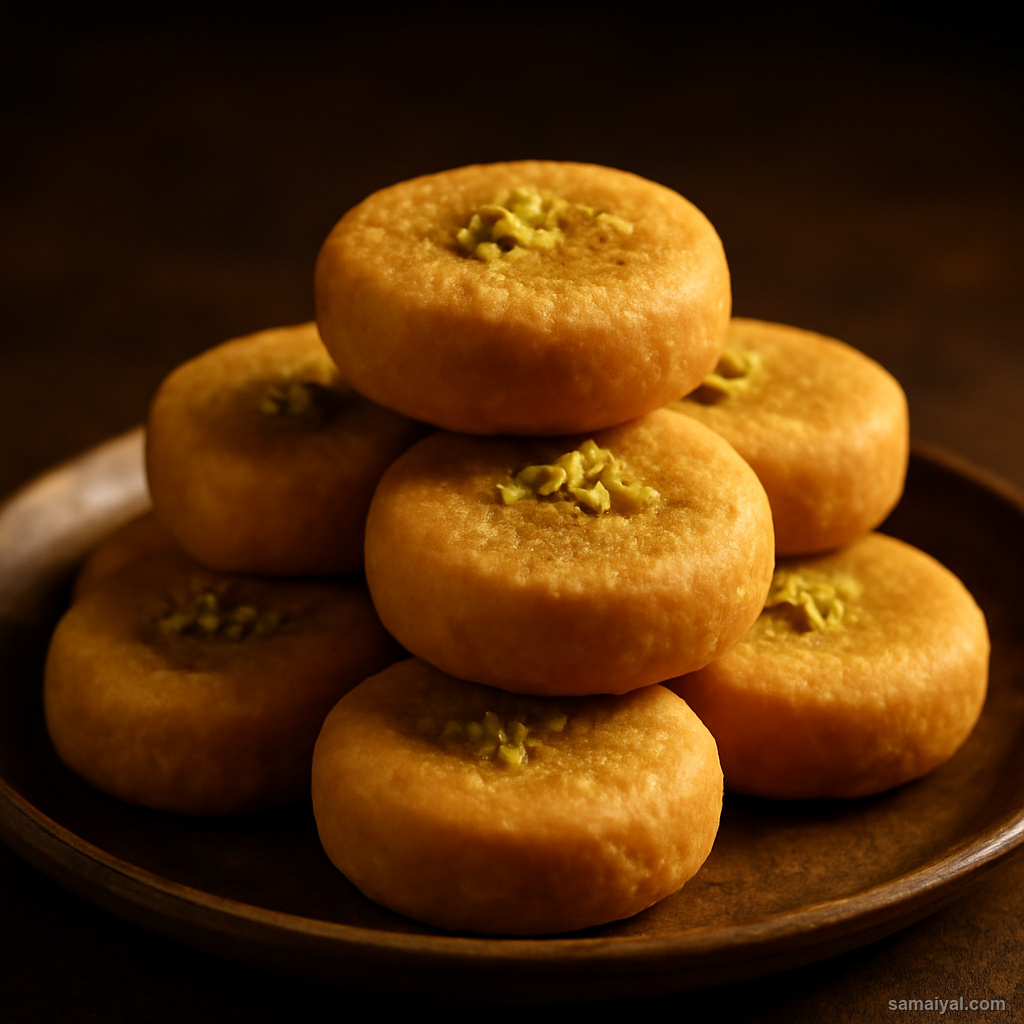
Soft discs of slow-cooked, dried whole milk (khoya) mixed with sugar and cardamom — the most well-known sweet of Mathura, associated with Lord Krishna. Distributed as prasad at temples and gifted at every occasion.
Crumble the khoya: Take 400 g khoya and crumble it with your hands into a wide heavy pan. Khoya is a firm block of dried milk — it should crumble easily. If it is very hard, grate it coarsely.
Cook the khoya on low heat: Place the pan on low heat. Cook the crumbled khoya while stirring continuously. As it heats, the khoya will first soften and become grainy, then smooth and flowing like a thick paste. Continue stirring for 8 to 10 minutes until the khoya turns a deeper golden colour and smells roasted and milky.
Check the roasting: Take a small amount of the hot khoya between your fingers when slightly cool — it should feel smooth and slightly sticky. If it feels wet and loose, cook for 3 more minutes. If it feels crumbly and dry, the khoya was over-cooked — add 1 tbsp warm milk and stir.
Remove from heat: Take the pan completely off the heat. Let the cooked khoya cool for 5 minutes — it should be warm but not burning hot.
Add sugar, saffron and cardamom: Add powdered sugar, saffron milk and cardamom powder to the warm khoya. Mix well with a spoon — the sugar will melt slightly from the warmth of the khoya.
Knead gently: Using your hands, gently knead the khoya-sugar mixture for 2 minutes until it comes together into a smooth, uniform dough. It should be pliable and slightly tacky.
Divide into equal portions: Divide the khoya mixture into 16 to 18 equal portions. Roll each into a smooth ball.
Shape the peda: Flatten each ball between your palms into a thick disc — about 3 to 4 cm in diameter and 1.5 cm thick. Press the edges to make them smooth and even.
Decorate: Press one almond slice or a few pistachio slivers into the centre of each peda. Optionally, make a small design with a toothpick on the surface.
Cool and serve: Let the shaped peda cool completely at room temperature for 15 minutes — they will firm up. Serve or store in an airtight container for up to 1 week at room temperature.
Note: Mathura Peda is inseparably linked to the city of Mathura — the birthplace of Lord Krishna — in Uttar Pradesh. The peda is distributed as prasad at all the major temples in Mathura and Vrindavan. Buying Mathura Peda is considered an essential part of visiting these pilgrimage towns. Every sweet shop in Mathura has its own formula, and the competition between shops is intense. The Mathura peda is always brown in colour from the roasted khoya — much darker than the pale pedas made elsewhere.
⭐ Featured
Soft milk-solid dumplings soaked in fragrant rose sugar syrup — India's most beloved sweet.

Slow-cooked rice pudding with cardamom, saffron, nuts and rose water — pure comfort in a bowl.

Slow-cooked grated carrot pudding with ghee, milk and cardamom — a winter celebration classic.

Spongy soft chenna balls cooked in light sugar syrup — the iconic Bengali sweet.
Comments & Tips
Be the first to share your experience with this recipe!
Leave a Comment