 ⭐ Featured
Aloo Paratha
Stuffed whole-wheat flatbread with spiced potato filling — the quintessential Punjabi...
Deep-fried puffed white flour bread — the celebratory Assamese breakfast for festivals
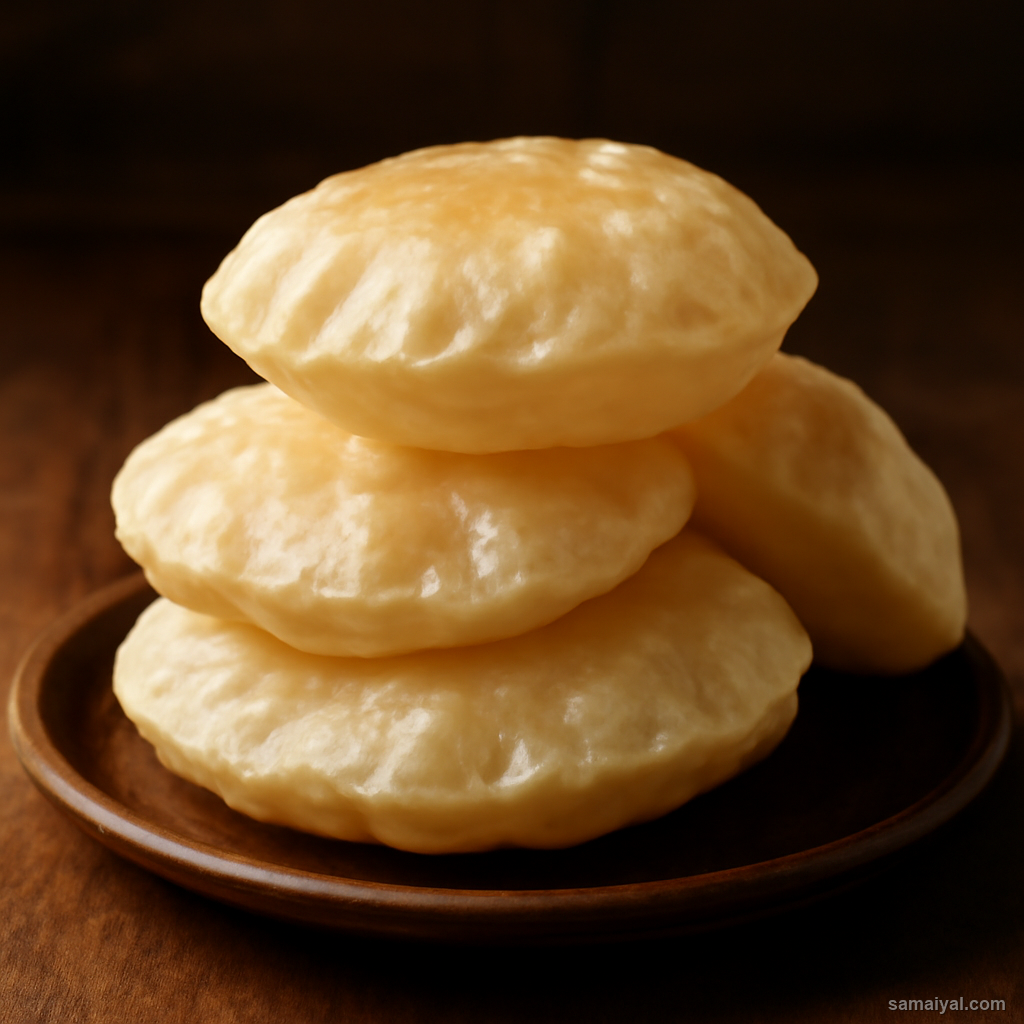
About Luchi: Luchi is the festive breakfast bread of Assam — deep-fried puffed white flour bread eaten with potato curry, chickpea curry, or even kheer at celebrations. Unlike puri made from whole wheat, luchi is made from refined flour (maida), giving it a delicate, almost translucent character that puffs dramatically in hot oil. It is the quintessential celebration bread of Eastern India.
Choose fresh maida: Use 2 cups of all-purpose flour (maida). Old or stale maida produces tough, dense luchi. Sift before measuring for the most consistent results.
Mix the dry ingredients: In a wide bowl combine the 2 cups maida and 1/2 tsp salt. Whisk briefly with a fork to distribute the salt evenly.
Add the oil: Add 1 tsp neutral cooking oil to the flour. Use cold oil, not warm. Rub the oil into the flour with your fingertips for 1-2 minutes — the mixture should look like coarse breadcrumbs.
The gradual water addition: Have 1/2 cup warm (not hot) water ready. Pour about 1/4 cup over the flour. Mix with a fork at first, then your fingers as the dough comes together. Add 1-2 tbsp more water as needed.
Knead to a stiff smooth dough: Knead for 5-7 minutes on a clean work surface. Push the dough away with the heel of your palm, fold back, turn 90 degrees, repeat. The dough should be stiff (firmer than chapati or roti dough), smooth, and slightly springy. Stiff dough is essential for proper luchi puffing.
Check the dough: Press with a finger — the dough should resist slightly and bounce back slowly. If too soft, knead in 1 tbsp more flour. If too dry and cracking, sprinkle 1 tsp warm water and knead in.
Rest the dough: Cover with a damp cloth and rest for 15 minutes. Resting relaxes the gluten and lets the dough hydrate fully.
Divide into balls: After resting, pinch off small marble-sized portions of dough — about half the size of typical roti balls. You should get 12-15 balls. Roll each between your palms into a smooth ball with no cracks. Keep them under the damp cloth as you work.
The oil temperature is critical: Pour neutral cooking oil into a deep heavy pan to a depth of at least 5cm. Place over medium-high heat.
Test the oil temperature: Drop a tiny piece of dough into the oil. It should sink briefly, then rise to the surface within 3-4 seconds and start sizzling vigorously. The oil should be hot enough to puff but not so hot that the luchi browns before puffing.
Roll thin: Take one dough ball. Dust very lightly with flour (do not over-flour — extra flour falls into the oil and burns). Roll on a clean work surface into a thin disc, about 8-10cm wide and 2-3mm thick. Aim for thin and uniform.
The critical no-tear technique: If the disc tears or has a hole, the luchi will not puff during frying. If torn, gather and re-roll.
Fry one at a time: Slide the rolled disc carefully into the hot oil, away from yourself. Within 2-3 seconds the luchi should sink briefly then rise.
The pressing technique to encourage puffing: Use a slotted spoon to gently press the back of the floating luchi into the hot oil. Press lightly — the pressure forces steam to build inside, which is what puffs the bread. After 5 seconds of pressing, the luchi should puff up dramatically into a balloon shape.
Fry until light golden: Once puffed, fry for 30-45 more seconds, turning once with the slotted spoon. The luchi should be light golden — pale gold, not deep brown. Over-fried luchi tastes bitter.
Drain on paper or rack: Lift each luchi out with a slotted spoon. Drain briefly on a wire rack (best for keeping them puffed) or kitchen paper.
The deflate is normal: After 2-3 minutes off heat, the luchi will partially deflate. This is normal and expected.
Work in batches: Continue rolling and frying one luchi at a time. Working solo, you can roll the next one while one is frying.
Keep warm: If serving multiple luchi, keep them warm wrapped in a clean kitchen towel or in a covered casserole. Do not stack while still oily — they will go soggy.
Serve immediately: Luchi taste best within 30 minutes of frying. They are most beautiful and crispy fresh.
Serving suggestions: Traditional pairings include aloo dum (potato curry), dal, kheer, or chickpea curry. The Assamese festive breakfast is luchi with aloo bhaji and a small sweet on the side.
Leftover storage: Cooled luchi keep at room temperature for 4-5 hours. Refresh by warming briefly in a hot dry pan for 30 seconds per side. They go soft after refrigeration; better to make fresh.
A cultural note: Luchi is shared between Assamese, Bengali and Bihari food traditions — the same bread crosses regional boundaries. The festive symbolism is universal across all three cuisines.
⭐ Featured
Stuffed whole-wheat flatbread with spiced potato filling — the quintessential Punjabi...
 ⭐ Featured
Thin crispy rice-lentil crepe filled with spiced potato masala — the iconic South...
 ⭐ Featured
Steamed fermented rice cakes served with tangy lentil vegetable soup — South India's...

Crispy ring-shaped lentil fritters with fluffy interior — a South Indian must-have with sambar.
Comments & Tips
Be the first to share your experience with this recipe!
Leave a Comment