 ⭐ Featured
Butter Paneer Masala
Creamy tomato-based curry with soft paneer cubes — the all-time favourite of Indian...
River fish wrapped in fresh turmeric leaf and steamed — deeply fragrant Assamese technique
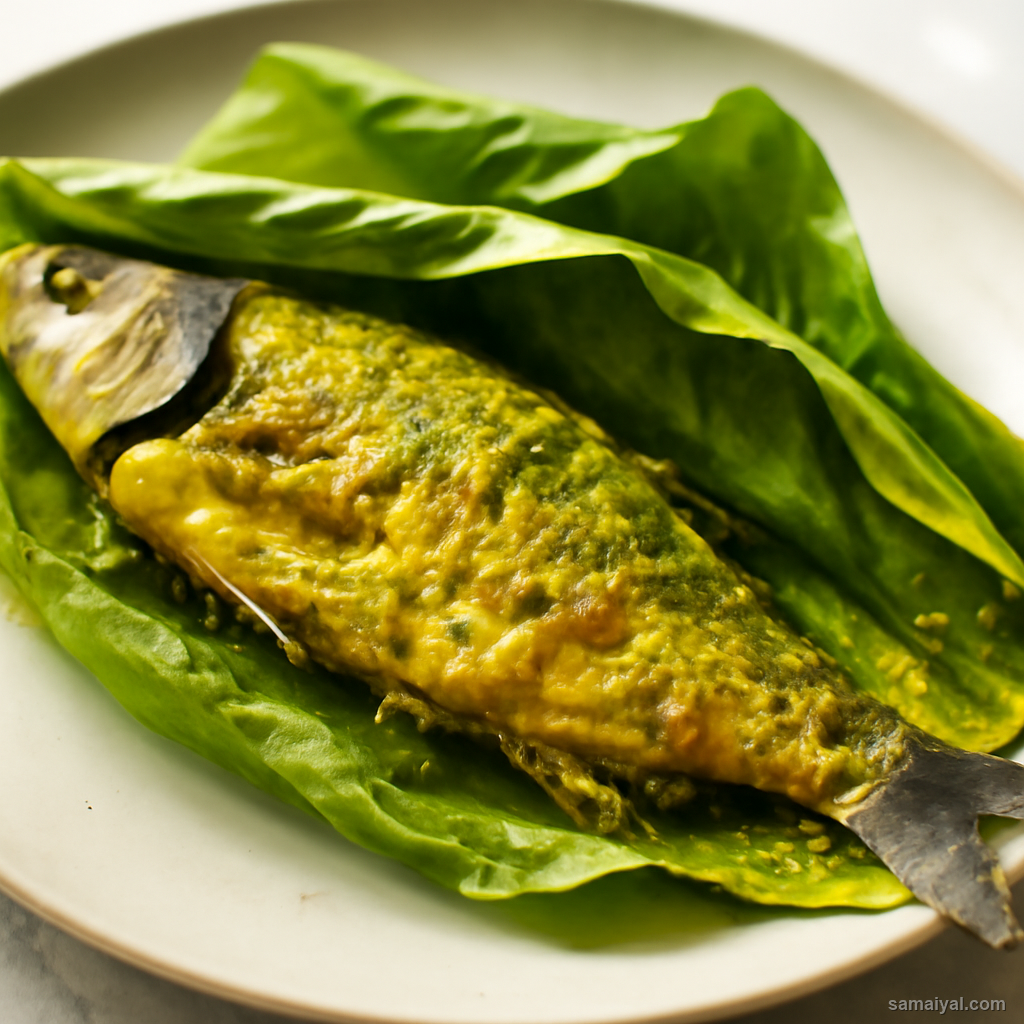
About Fish in Turmeric Leaf: Fresh turmeric leaves impart a unique fragrant warmth — somewhere between cardamom and lemongrass — to anything steamed or grilled inside them. This is a uniquely Assamese (and partly Konkani) technique, treasured for the way the leaf transforms a simple piece of fish into something perfumed and special. Worth making whenever you find fresh turmeric leaves at an Asian or Indian grocery.
Finding turmeric leaves: Fresh turmeric leaves (called haldi paat or halodhi paat) are seasonal and best found in spring and summer at Indian or Asian groceries. They are long, lance-shaped, bright green leaves with a wonderful citrusy fragrance when bruised. Look for the freshest leaves — wilted leaves lose their fragrance.
Substitute if needed: If turmeric leaves are unavailable, banana leaves work as a wrapping but provide much less flavour. To compensate, add 1/4 tsp turmeric powder and a few fresh curry leaves to the marinade. Pandan leaves are another possible substitute.
Choose the fish: Use 400g firm white fish fillets. Bhetki (barramundi) is most traditional. Other excellent choices: tilapia, sea bass, snapper, halibut, or even firm river fish. Avoid very soft fish like cod which falls apart.
Prep the fish: Cut the fillets into 4 portions of about 100g each — single-portion sized pieces wrap most cleanly in a leaf. Pat completely dry with kitchen paper. Wet fish does not absorb marinade well.
Make mustard paste: This is the second key flavour. Soak 2 tbsp yellow mustard seeds (or a mix of yellow and black) in 3 tbsp water for at least 30 minutes. Drain. Grind in a mortar with 1 green chilli and 1/4 tsp salt to a smooth paste — about 1 tsp of finished paste needed for this recipe. Or use 1 tsp ready-made Bengali kasundi mustard paste.
Build the marinade: In a bowl, combine the mustard paste, 1/2 tsp turmeric powder, 1 tsp finely chopped green chilli, 1/4 tsp salt, and 1 tsp mustard oil. Mix into a thick paste.
Marinate the fish: Spread the marinade evenly over each fish portion, top and bottom. Use your fingers to massage gently. Let marinate at room temperature for 15 minutes — long enough to penetrate, short enough not to "cook" the fish chemically with the salt.
Prepare the leaves: Take 4 large fresh turmeric leaves. Wash gently under cold water. Pat dry with a kitchen towel. Trim the very tips and stems if jagged.
Warm the leaves: Hold each leaf briefly over a low gas flame for 2 seconds on each side, or pass over a hot dry pan for 5 seconds. This makes the leaves pliable and brings out the fragrance — they will not crack when folded. Do not actually cook them, just warm them.
Wrap the fish: Place a marinated fish portion in the centre of a turmeric leaf, slightly off-centre. Fold the leaf over the fish lengthwise, then fold the ends underneath to make a closed parcel. The parcel should be neat with no fish exposed.
Secure the parcel: Fix with a toothpick driven through the layers of leaf, or tie with kitchen string. Make all 4 parcels in the same way and arrange on a plate.
Set up the steamer: Bring water in a steamer to a rolling boil. Use a bamboo steamer over a wok, or a fitted steamer pot — both work. Line the steamer basket with another turmeric leaf or banana leaf if available.
Steam the parcels: Place the parcels in the steamer in a single layer, with space between them so steam circulates. Cover and steam over high heat for 12 minutes for thinner fillets, 15–18 minutes for thicker pieces.
Check doneness: Remove one parcel carefully — it will be very hot. Open a corner. The fish should be opaque white, flaky when pressed with a fork, and the leaf should be a deeper green and intensely fragrant.
Rest 2 minutes: Let the parcels rest covered for 2 minutes off the heat. The fish continues to cook slightly and the flavours settle.
Serve in the leaf: Arrange the parcels on individual plates, still wrapped. The drama of unwrapping the parcel at the table — and the burst of fragrance — is part of the experience. Each diner unwraps their own.
Serve with: Steamed rice, a wedge of lemon, and a small bowl of mustard oil with sliced raw onion and green chilli on the side. The leaf is not eaten — set it aside as you eat the fish.
⭐ Featured
Creamy tomato-based curry with soft paneer cubes — the all-time favourite of Indian...
 ⭐ Featured
Velvety spinach curry with golden-fried paneer — nutritious, vibrant and absolutely delicious.

Bold, tangy chickpea curry packed with spices — a street food staple that works as a main dish.

Dry-spiced potatoes and cauliflower — simple, aromatic, and endlessly satisfying.
Comments & Tips
Be the first to share your experience with this recipe!
Leave a Comment